
Five measurements, a soft tape or a shoelace, and a few tricks for children who refuse to hold still.
Quick answer
To measure a child for clothes, take height, chest, waist, hips and inseam over a thin layer with shoes off, using a soft tape in cm. Babies under two are measured lying down. For kurtas, sherwanis and lehengas, add 1 to 2 cm to chest and waist.
You do not need a tailor’s kit to size a child’s clothes. A soft tape measure, a bare wall and about five minutes will do. The hard part is rarely the tools. It is the toddler who treats the tape like a toy, or the baby who objects to lying flat.
This article covers the measuring. Once you have your numbers, our kids clothing size guide for India shows how to match them to a brand chart and what to do when your child falls between two sizes.
What you need before you start
A soft tape marked in both cm and inches is the best choice. A steel builder’s tape will not bend around a chest. If the house only has a shoelace or a piece of string, that works too: wrap it around the body part, mark where it meets, then lay it flat next to a ruler.
Measure over a vest or a thin t-shirt, never over a hoodie, jacket or pyjamas with padding. Bulky layers push every number up, and you end up buying a size that hangs. Shoes come off for height and inseam. Write the numbers in cm. Some Indian brands, Nesavu for one, list chest and waist in inches, so keep 1 inch = 2.54 cm handy.
The five measurements and where to take them
| Measurement | How to take it | Matters most for |
|---|---|---|
| Height | Barefoot, feet together, back against a wall. Mark the top of the head, then measure floor to mark. | Almost every size decision |
| Chest | Around the fullest part, under the arms. Keep the tape level and snug, not tight. | Tops, kurtas, frocks, sherwanis |
| Waist | Around the natural waist. Have your child bend sideways: the crease that forms is the waist. | Trousers, skirts, lehengas, dhotis |
| Hips | Around the fullest part of the hips and bottom, heels together. | Fitted trousers, leggings, dresses |
| Inseam | Take a pair of trousers that already fit well. Measure along the inner seam, crotch to hem. | Trousers, jeans, pyjamas |
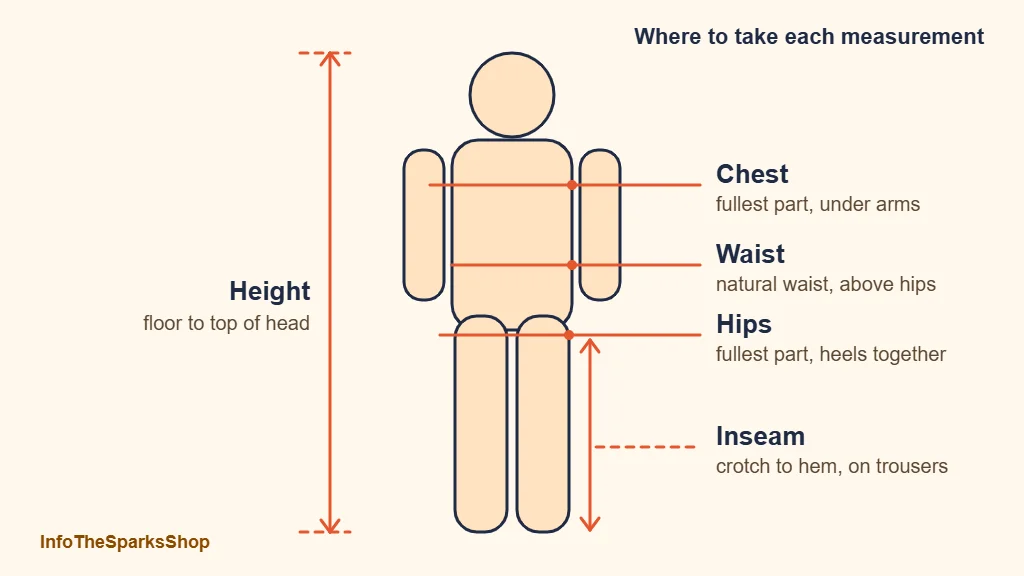
Two notes on that table. For height, use a flat, uncarpeted floor so the feet sit properly, as Canada’s SickKids hospital advises for measuring at home. And for inseam, measuring a pair of trousers beats measuring the child. Nobody enjoys holding a tape against a toddler’s inner thigh.
Toddlers also do not have a defined waist the way adults do. Their midsection moves when they breathe or bend. Take each measurement twice, and if the two readings differ because the child moved, go with the larger one.
Festive and ethnic wear needs one extra step. Woven fabrics such as raw silk and cotton-silk have little or no stretch, and kurtas, sherwanis and lehengas are cut close, so add about 1 to 2 cm to the chest and waist measurements before you pick a size. A kurta that fits on the tape but cannot move at the shoulders will not last past the first photo.
Babies, and children who will not stand still
Doctors measure babies under two lying down, and call it length rather than height. You can do the same for clothes. Lay your baby on their back on a bed, straighten the legs gently, and measure from the top of the head to the heel. A second person helps a lot, to hold the tape end and to keep the baby busy. Chest is measured under the arms around the widest part, and hips at the widest point with the feet together.
If your baby will not lie flat and you measure standing, the number will be slightly off. The difference is small: lying length runs about 0.7 cm more than standing height, according to a University of Hawaii nutrition course. For buying clothes, that does not change the size.
Toddlers are the real challenge. A few things that work:
- Lay them flat on their back for the length, then check again standing.
- Use the fridge trick. Stand them against the fridge, mark the top of the head with a magnet, then measure from floor to magnet.
- Pick a calm moment, such as just after a bath or when they are drowsy. This one is our own suggestion, but it works better than chasing them after play.
- Measure the chest and waist first. Height is the easiest to fudge afterwards because you can mark it on the wall in a second.
Older children are easier. Make it a game, or let them hold the end of the tape.
Go by length, not by age
The label on baby clothes and your child’s actual age rarely line up. Two babies born on the same day can need different sizes, because length is what counts. If your measurement and the label disagree, follow the measurement.
Keep a note on your phone with the date, height, chest and waist. Re-measure before a big purchase such as festive outfits, and every couple of months for babies and toddlers, who outgrow sizes quickly. For babies in particular, our guide to the best clothes for baby boys and girls in India covers how many pieces to buy per size so you are not left with unused newborn wear.
What to do with the numbers
Compare your child’s height, chest and waist with the chart on the exact product page. Charts differ from brand to brand, so a size 24 at one shop is not a size 24 at another. If you land between two sizes, check the exchange window before you order. Our guide on how to shop fashion online in India explains what to look for in a return policy.
Frequently asked questions
How do you measure a child for clothes?
You need five numbers: height, chest, waist, hips and inseam. Do it over a thin layer with shoes off, keep the tape flat and gently snug, and record everything in cm.
How do I measure a toddler who won’t stand still?
Start with the length while they lie down, and have someone keep them busy. Read each number twice. A piece of string is easier to wrap around a squirming child than a stiff tape.
How do you measure a child’s inseam?
Use trousers your child already wears comfortably and run the tape up the inside leg, from the crotch seam to the bottom edge. That beats measuring a moving leg.
How often should I re-measure my child?
Every couple of months for babies and toddlers. For older kids, measure again before a big purchase, or when sleeves and hems start looking short.
Should I measure over clothes?
A thin vest or t-shirt is fine. Anything thicker adds bulk and pushes the numbers up, so you end up ordering too big.



Pingback: Kids Trousers Size Guide India: Waist and Length by Age