Why the same age can mean an 18 inch waist in one brand and 22 inches in another, and how to pick the right pair anyway.
Quick Answer
For a kids trousers size guide, match your child’s waist and height to the brand chart, not the age label. Most children aged 4 to 10 need a waist of roughly 18 to 26 inches, depending on the brand. Choose by length first, because kids outgrow trouser length before they outgrow the waist.
Order three pairs of trousers labelled “6 years” from three different sites and you will often get three different fits: one loose enough to need a belt, one right, one that will not close. Nothing is wrong with your child or the shops. The labels simply do not mean the same thing.
That is the real problem with trouser sizing. This guide shows where two brands actually differ, which measurement to trust, and how to choose between sizes. If you have not measured your child yet, start with how to measure a child for clothes, then come back here. For tops and kurtas, our kids clothing size guide for India covers chest sizing.
What two real size charts say about the same age
We compared the waist figures printed by two brands that sell to Indian parents: Nesavu, an Indian kidswear label, and Plan B, which lists its shorts by age and height. Both are in inches.
| Age | Nesavu waist (in) | Plan B waist (in) | Gap |
|---|---|---|---|
| 4 years | 18 | 21.5 to 22.5 (4 to 6 y) | about 3.5 to 4.5 |
| 6 years | 20.5 | 22.5 to 24 (6 to 8 y) | about 2 to 3.5 |
| 8 years | 22 | 24 to 26 (8 to 10 y) | about 2 to 4 |
| 10 years | 24 | 25 to 27.5 (10 to 12 y) | about 1 to 3.5 |
Plan B groups two years into each row, so the match is not exact, and the two brands may measure different things. The Nesavu chart appears to list finished garment sizes for elastic, drawstring waists, which sit smaller until stretched. Plan B lists body waist ranges. Whatever the reason, the practical point stands: a “6 year” pair can differ by 2 inches or more in the waist depending on the label.
So treat age as a rough hint. The only numbers worth comparing are your child’s own waist and height against the chart on the exact product page.
Waist first, or length first?
Length. This surprises most parents, but children grow taller faster than they grow wider. In a growth spurt a child can add several centimetres of height while the waist barely moves. That is why trousers go short at the ankle months before they feel tight.
Most kids trousers sold in India have an elastic or drawstring waist, which forgives a mismatch of an inch or so. A hem does not forgive anything. So when you are choosing between two sizes, ask whether the length works, then check that the waist is within about an inch.
For woven cotton or twill trousers with a flat button waist, reverse that order. These do not stretch, so the waist number has to be right, and the length can be fixed with a hem.
Length is where most online orders go wrong, so here is a reference. The Name It kidswear size guide lists inside leg (inseam) against height for children aged 6 to 10. Nesavu lists the finished length of its shorts by age.
| Height | Inseam, Name It (cm) | Age | Nesavu shorts length (in) |
|---|---|---|---|
| 116 cm | 52.5 | 6 years | 14.5 |
| 122 cm | 56 | 7 years | 15 |
| 128 cm | 59 | 8 years | 16 |
| 134 cm | 62 | 9 years | 17 |
| 140 cm | 65 | 10 years | 18 |
These two columns come from different brands and different garments, so read them as ranges rather than rules: inseam grows about 3 cm for every 6 cm of height. I could not find a published Indian brand chart for children under 116 cm, so for toddlers measure a pair that already fits and add 2 to 3 cm.
How trousers should fit, by type
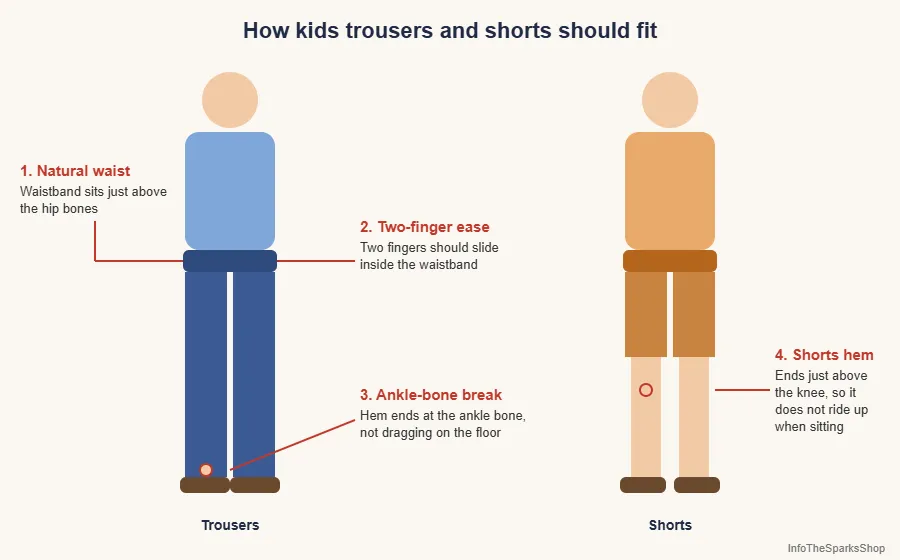
Jeans and chinos should sit at the natural waist with room for two fingers inside the waistband. Joggers and track pants can be a little looser, and a small amount of bagginess at the ankle is normal. Leggings are the exception: a size up makes them bag at the knee, so buy the true size.
Shorts need their own check. For a child under 8, the hem should land just above the knee. Shorts that end at the knee ride up when the child sits cross legged, which is how school and play hours go. Nesavu’s chart pairs a 4 year waist of 18 inches with a length of 12 inches, and a 10 year waist of 24 inches with 18 inches, which gives you a sense of how fast length climbs.
If your child is between two sizes
Nesavu suggests going up a size, and that is sound advice for elastic waists. Go up if the waist is elastic, the fabric is cotton that may shrink slightly in the first wash, or the child is close to a growth spurt. Stay with the smaller size for flat button waists, fitted school trousers and anything that has to look neat for an event.
One habit that saves money: buy one size up and roll the hem once or twice for the first few months. It looks fine on casual wear, and the pair lasts a second season.
Frequently asked questions
What is the size chart for kids pants?
There is no single standard. Sizes follow age and height ranges that change by brand, so the safest chart is the one on the product page. As a guide, Nesavu lists waists from 18 inches at age 4 to 24 inches at age 10, while Plan B lists about 21 to 22.5 inches at ages 4 to 6 and 25 to 27.5 inches at ages 10 to 12.
What size pants does a 5 year old wear?
Usually a waist of about 19.5 to 23 inches and a height of about 109 to 117 cm, depending on the brand. Nesavu’s chart gives a 19.5 inch waist for 5 years, while Plan B’s 4 to 6 years row gives 21.5 to 22.5 inches. Check height as well as waist before you order.
How should kids pants fit?
Snug at the waist with two fingers of room, and long enough to reach the ankle bone without dragging on the floor. If your child cannot sit, squat and climb stairs comfortably, the pair is too small.
Should I buy kids pants a size bigger?
Yes for elastic waists, if your child is close to a growth spurt or the fabric is cotton. Not for flat button waists or school trousers, which hang badly when oversized. Rolling the hem makes a size up easier to live with.
How do I measure my child for pants?
Measure the waist at the natural waist, the height barefoot against a wall, and the inseam on a pair that already fits. Take each reading twice. Our measuring guide walks through all five measurements and what to do with a child who will not stand still.
Before your next order, write down your child’s waist, height and inseam on one note in your phone, then compare them with the chart on the product page, not the age on the label.