
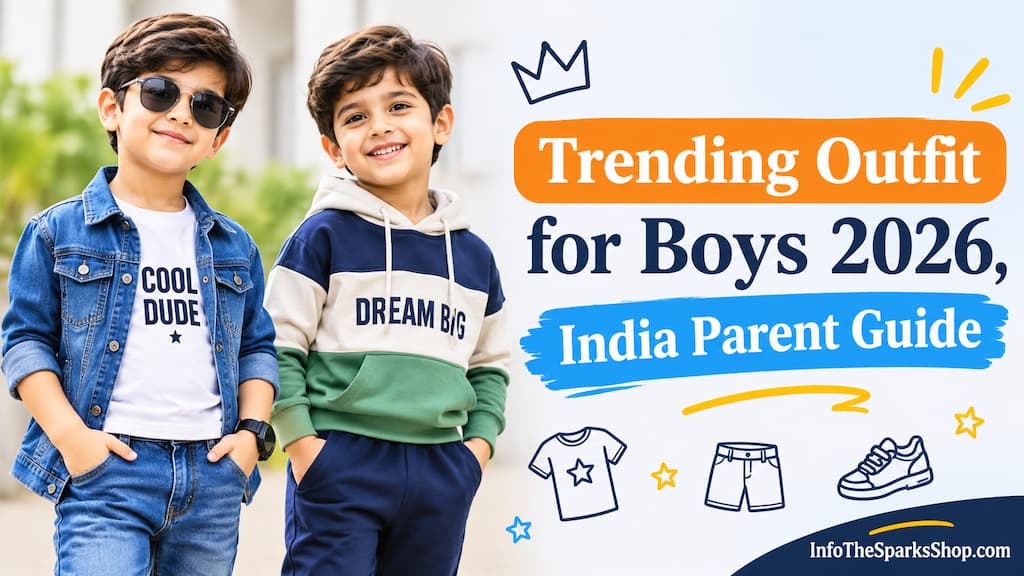
When an Indian parent searches for trending outfits for boys, they are rarely just curious about fashion. They are usually standing in front of a child who has a birthday party this weekend, a school function next week, or a cousin’s wedding next month, and they need to know what to buy right now.
The answer changes depending on the occasion, the child’s age and the city they are in. A 4-year-old in Chennai needs something very different from a 10-year-old in Delhi. What works for a casual birthday party at a friend’s house is not what you want at a formal family function. And the fabric choices that make sense in Mumbai in June are different from what you need in Jaipur in November.
This guide covers trending boys outfits in India in 2026 by occasion, casual and daily wear, school, party, ethnic and festive, and Indo-Western, with specific age guidance and honest budget notes throughout.
Casual and Daily Wear, The Outfits That Get the Most Use
The category Indian parents spend the most time on is also the one that gets the least attention in fashion guides: what boys wear every day. Not for a special occasion. Just to play, to be at home, to run around in.
In 2026, the dominant casual trend for Indian boys between 4 and 12 years is the graphic printed T-shirt paired with cargo joggers or slim-fit track pants. This combination has been building since 2024 and is now solidly mainstream, the kind of outfit you see on every second child at a birthday party or at a park on a Sunday morning. The appeal is obvious: boys are comfortable in it, it holds up to the abuse of active play and it is easy to wash. Colours trending strongly this year are electric blue, deep forest green and burnt orange, moving away from the safe navy-grey-white palette that dominated the previous few years.
For younger boys between 2 and 5 years, dungaree sets remain a favourite for parents because they are practical, stay tucked during play and come in enough variety to feel fresh. The current trend leans toward lighter fabrics, cotton linen blends, rather than the heavier denim dungarees that were popular earlier. This matters particularly for children in coastal cities like Mumbai and Chennai where humidity makes heavier fabrics uncomfortable through most of the year.
One pattern that has picked up significantly in 2026 is the co-ord set: matching printed shorts and T-shirts sold as a pair. Parents like them because the outfit decision is made in one purchase, the colours are coordinated without any effort and they photograph well. They are also a practical size guide because if the shorts fit, the T-shirt will too.
School Wear, Comfortable, Durable and Easy to Move In
Most Indian schools have fixed uniform requirements, which makes this category seem simple, but a significant portion of school-related clothing purchases are for non-uniform days, sports days, annual functions and casual Friday policies that many schools have adopted.
For non-uniform school days, the dominant trend among Indian boys in 2026 is relaxed-fit denim jeans or chinos paired with a plain or printed polo T-shirt. Not a formal look, not too casual, the kind of outfit a school-age boy feels confident in without looking overdressed. Polo T-shirts in particular have had a strong year in kidswear because they read as slightly more put-together than a plain round-neck T-shirt without requiring any additional effort.
For sports days and physical activities, dry-fit fabric has become the expected standard rather than a premium option. Cotton T-shirts for physical activity are increasingly being passed over in favour of lightweight polyester blend jerseys that manage sweat better. Indian summers are genuinely harsh and a child who is comfortable during school sports is a child who is not complaining at the end of the day.
Annual function and stage performance outfits are a separate consideration entirely. Most Indian school annual functions have a theme and parents are often left scrambling for something specific on short notice. The practical advice here is to have one well-fitted kurta pyjama set in white or ivory already in the wardrobe. It works for almost every school function theme, photographs beautifully and is genuinely versatile across occasions.
Party Wear, What Is Actually Trending at Birthday Parties
Birthday parties are the biggest driver of boys party wear purchases in India, and the trend in 2026 has moved away from the formal shirt-and-trousers look that dominated Indian children’s party wear for a decade. Parents and children have both become more comfortable with slightly relaxed party outfits, and brands have responded.
The strongest current trend for boys party wear is the printed shirt in a relaxed or camp-collar style, paired with well-fitted trousers or chinos. Not a formal dress shirt, something with a pattern, a character print or a bold colour that reads as festive without being stiff. Cotton linen is the fabric of choice because it looks put-together but does not make a child miserable at an outdoor party in Indian weather.
For younger boys between 3 and 7 years, the waistcoat set has become very popular for birthday parties and family celebrations. A kurta or shirt base with a contrast waistcoat on top gives a layered, dressed-up look without the full formality of a sherwani. These sets are widely available at Firstcry, Hopscotch and on Myntra’s kids section in the Rs 500 to Rs 1,500 range, affordable enough that parents do not stress if it gets cake on it.
One consistent observation from parents shopping for party wear: boys grow out of occasion wear faster than it wears out. The practical advice is to buy party wear one size up rather than exactly the current size. It gives another full year of use, and for non-structured pieces like printed shirts and kurtas, a slightly larger size reads as relaxed rather than too big.
Ethnic and Festive Wear, What Sells Most and Why
Indian ethnic wear for boys is not one category, it is several, and they do not overlap as much as most guides suggest. What a 6-year-old wears to Diwali at home is not what he wears to a cousin’s wedding, which is not what he wears to a Ganpati celebration in Maharashtra or an Onam function in Kerala.
The kurta pyjama set remains the most versatile and most purchased ethnic outfit for Indian boys across all age groups. In 2026, the dominant aesthetic has moved toward cleaner designs, fewer sequins, lighter embroidery, more block prints, because parents have realised that a heavily embellished kurta will not be worn more than once or twice before the child refuses to put it on. A simple cotton kurta in a rich colour holds up better and gets far more use.
For weddings and very formal family occasions, the Indo-Western combination, a kurta base with a Nehru jacket or a structured jacket on top, has largely replaced the full sherwani for boys under 10. Sherwanis are heavy, warm and restrict movement significantly. A Nehru jacket set is lighter, looks equally formal in photographs and is something a child will actually wear without protest. This shift has been consistent across the market since 2024 and is now the dominant choice for boys between 5 and 12 at wedding functions.
Regional ethnic wear deserves specific mention because the buying decisions differ entirely by state. In South India, Tamil Nadu, Kerala, Karnataka, Andhra Pradesh, the dhoti or veshti set with a shirt or kurta remains the standard for temple visits, family functions and festivals like Onam and Pongal. For North Indian families, the kurta pyjama is the default across all occasions. For Gujarati and Rajasthani families, the bandhani print or mirror-work kurta has a specific cultural context that plain kurtas do not replace.
Indo-Western, The Trend That Has Completely Taken Over Festive Fashion
If one trend defines boys fashion in India in 2026, it is the mainstreaming of Indo-Western styling. What was considered experimental or premium five years ago, a kurta with jeans, a Nehru jacket over a plain white T-shirt, a printed jacket over western trousers, is now standard at birthday parties, family dinners and casual festive occasions.
The appeal for parents is practical: Indo-Western outfits are easier to mix and match than dedicated ethnic sets, they are more comfortable for children to wear for extended periods and they photograph well in both formal and casual settings. The appeal for boys, particularly older ones between 8 and 12, is that Indo-Western does not look like they are being dressed up in costume, it feels contemporary in a way that a full sherwani does not.
The most popular Indo-Western combination for Indian boys in 2026 is a solid or subtly printed kurta top worn with slim straight-fit jeans or dark chinos, with white sneakers finishing the look. This works across a wide range of occasions from birthday parties to family functions to school annual day events. Brands like Hopscotch, H&M Kids and several Firstcry house brands have made this the centre of their festive collections this year.
For younger boys between 3 and 7, the kurta-jacket set, a simple kurta with a Nehru or mandarin collar jacket, is the Indo-Western format that resonates most with parents because it looks complete without requiring additional styling choices. It is essentially one outfit decision rather than a mixing exercise, which suits parents who do not have time to coordinate separates.
ALSO Read:
Fabric, The One Thing Most Fashion Guides Skip for Indian Conditions
Indian parents know from experience that a beautiful outfit that makes a child uncomfortable is an outfit that will not be worn a second time. Fabric choice is the single most practical decision in boys clothing and it is almost entirely ignored in trend coverage.
For most of India for most of the year, the correct answer is 100 percent cotton or a cotton linen blend. Cotton breathes. It absorbs sweat. It tolerates multiple washes. It does not irritate sensitive skin. A cotton kurta in Bengaluru in September and a cotton T-shirt in Jaipur in May are both correct choices for the same fundamental reason: the child will be comfortable.
Polyester and polyester blends are appropriate for specific use cases, dry-fit sportswear, certain types of party wear where the outfit needs to hold its shape, but polyester ethnic wear, which is widely available at lower price points, is a common trap. A polyester sherwani that costs Rs 800 less than a cotton one will make a child miserable at a three-hour wedding function and will be refused the next time.
Rayon and viscose fabrics have become common in boys kurta sets because they drape beautifully, photograph well and are cheaper than cotton. They are also uncomfortable in Indian heat and humidity, pill after a few washes and do not hold up the way cotton does. They look good in the store and in photographs. They do not survive Indian children or Indian weather.
One size advice that applies across all fabric types: when buying ethnic wear or occasion wear, order one size up. Children grow faster in height than in width, and a kurta that is slightly longer reads as a relaxed fit rather than too large. Going a size down to save money is a false economy, the outfit will not fit within three months.
Budget Guide, What Each Occasion Actually Costs
Daily and casual wear is the most price-sensitive category. A well-made printed T-shirt and jogger set for a boy between 4 and 10 years costs Rs 300 to Rs 700 from brands like Hopscotch and H&M Kids. At the lower end, Meesho and Firstcry’s house brands offer similar styles for Rs 150 to Rs 350. For items that will be worn daily and washed frequently, the mid-market range (Rs 300 to Rs 600) is usually the sensible choice, enough quality to survive regular use without overpaying.
Party wear typically runs Rs 500 to Rs 2,000 depending on whether it is a Western-style shirt-trouser combination or an ethnic waistcoat set. The Rs 800 to Rs 1,200 range is where the best value sits, enough construction quality that the outfit survives the occasion and can be worn two or three more times before being outgrown.
Ethnic and wedding wear is where costs jump most sharply. A basic kurta pyjama set for daily festive use starts at Rs 400 to Rs 800. A Nehru jacket set for a wedding runs Rs 1,200 to Rs 3,000. A full sherwani for a very formal occasion starts at Rs 2,500 and goes up quickly. The advice that saves most parents money is to skip the sherwani entirely for boys under 10, the Nehru jacket set looks equally formal, costs significantly less and gets worn more often.
Buying from Firstcry during their Big Baby Sale (typically January and July) or from Hopscotch during their end-of-season sale gives 30 to 50 percent discounts on exactly these categories. Buying one size up during these sales stretches the use of occasion wear by a full additional year, which at the rate boys grow is the most practical saving available.