
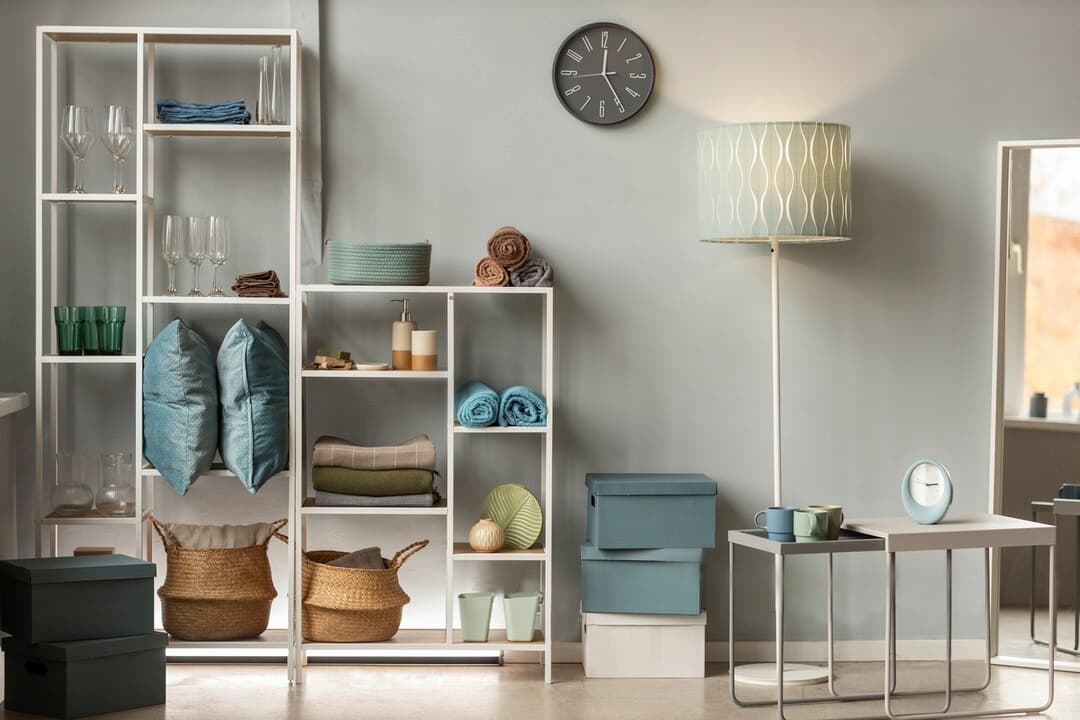
The average 1BHK flat in an Indian metro city today sits between 400 and 600 square feet. A 2BHK is typically 600 to 900 square feet. These are not small apartments by accident. They are the result of rising land prices, smaller household sizes in cities and a shift toward vertical living in metros like Mumbai, Bengaluru, Delhi NCR, Hyderabad and Pune.
What makes storage in Indian homes specifically challenging is not just the square footage. It is the inventory. An Indian household stores significantly more in the kitchen than a Western kitchen is designed for: pressure cookers in multiple sizes, a mixer-grinder, tiffin boxes for every family member, a wet grinder in many South Indian homes, steel vessels stacked in towers, a masala dabba, seasonal snack tins and large dals-and-rice containers. No generic storage guide addresses this inventory. This one does.
This guide is organised by room. Each section starts with zero-investment ideas that require no money, moves to low-investment ideas under Rs 2,000 and finishes with medium-investment ideas under Rs 15,000. Renter-specific alternatives are noted wherever drilling or wall-mounting is involved.
The Indian Storage Problem, What Generic Guides Get Wrong
Before room-by-room solutions it helps to understand what makes the Indian storage challenge specifically different from the storage challenges that most interior design content addresses.
| Indian Storage Reality | Why Generic Solutions Do Not Fit |
| Kitchen inventory is significantly larger than Western homes | Pull-out pantry designs sized for Western kitchens do not accommodate a pressure cooker collection a wet grinder and stacked steel vessels simultaneously. Indian kitchen storage needs custom vertical depth. |
| Seasonal storage is substantial | Diwali decoration boxes, winter razais and quilts, festival-specific cookware and clothing sets, Indian households rotate significantly more seasonal inventory than typical Western households. |
| Monsoon creates humidity and damp wall problems | Wall-mounted shelves and wardrobes placed against exterior or damp walls develop mould on stored items. Storage solutions for Indian homes must account for monsoon conditions particularly in coastal cities. |
| Most urban residents are renters | A large proportion of metro flat residents are tenants with no-drilling clauses in their rental agreements. Wall-mounted solutions that require drilling into concrete are not available to them without permission. |
| Loft space exists in most Indian homes but is wasted | The high shelf above the wardrobe opening or the space above kitchen cabinets, called the ooncha shelf locally, is present in nearly every Indian apartment and used mainly for dust collection. It is the single most underused storage zone in the Indian home. |
The Kitchen, India’s Most Storage-Challenged Room
Zero Investment, Reorganise Before You Buy Anything
• Group your steel vessels by size and nest them inside each other. Most kitchens have vessels placed randomly. Nesting reduces the space required by 40 to 60 percent immediately.
• Move the pressure cooker collection off the counter and into the lowest cabinet. Pressure cookers do not need to be accessible daily and their counter presence consumes the most valuable cooking workspace.
• Separate the items you use daily from items used weekly and monthly. Daily items go in the most accessible locations. Weekly items go one level deeper. Monthly items go to the highest or lowest shelves.
• Use the inside face of cabinet doors. A self-adhesive hook strip on the inside of a kitchen cabinet door costs Rs 80 to Rs 150 and stores spoon sets, ladles or even the masala dabba lid.
Low Investment, Under Rs 2,000
| Storage Solution | Approx. Cost | What It Solves |
| Stackable airtight containers for dal rice and grains | Rs 400 to Rs 800 for a set of 6 | Replaces bags and loose packets that take 3 times the shelf space. Stackable containers turn a chaotic shelf into an organised column. |
| Under-shelf basket (clip-on type) | Rs 150 to Rs 300 per piece | Doubles the capacity of any fixed shelf by creating a hanging layer below it. Works inside kitchen cabinets without drilling. |
| Wall-mounted magnetic knife strip | Rs 300 to Rs 600 | Frees up a full drawer. Can be adhesive-mounted for renters. |
| Expandable cabinet organiser for vessels | Rs 200 to Rs 500 | Creates tiered layers inside a single cabinet so multiple vessels are visible and accessible without lifting everything. |
| Over-door hanging organiser (hook-based) | Rs 300 to Rs 700 | Hangs over the kitchen door frame without drilling. Stores cleaning supplies, plastic bags or extra spice packets. |
Medium Investment, Rs 2,000 to Rs 15,000
• Pull-out drawer inserts for base cabinets (Rs 1,500 to Rs 4,000 per unit): Converts a deep cabinet into accessible layers. The most common problem in Indian kitchens is that items at the back of base cabinets are never reached because lifting and shifting stacked vessels is too inconvenient. Pull-out drawers solve this entirely.
• Wall-mounted spice rack above the cooking platform (Rs 800 to Rs 2,500): Puts the masala dabba and the 10 to 15 most-used spice containers within arm’s reach of the stove without occupying counter space.
• Pegboard panel for the kitchen wall (Rs 1,200 to Rs 3,000 installed): A pegboard with hooks stores utensils, small pans and even a paper towel roll. Renters can use a freestanding pegboard frame that leans against the wall without drilling.
The single highest-impact kitchen storage change in an Indian home is buying proper stackable containers for dal, rice, atta, poha, suji and other dry staples. Most kitchens store these in their original bags which cannot stack, collapse and waste enormous shelf space. A Rs 600 set of 6 airtight containers reorganises a full shelf.
The Bedroom, Making Every Centimetre Work
Zero Investment
• Declutter under the bed first. Most Indian beds have significant under-bed space that accumulates random items. Empty it completely, sort what is there and decide what actually needs to be accessible.
• Use the top shelf of the wardrobe for items you access less than once a month. Seasonal clothes, extra bedding, old documents. The eye-level to waist-level zone is prime real estate for daily-use items.
• Fold bedsheets using the KonMari vertical fold and store them standing upright in wardrobe shelves rather than stacked flat. A shelf that held 4 sets of flat-stacked sheets holds 8 to 10 sets when folded and stored vertically.
Low Investment, Under Rs 2,000
| Storage Solution | Approx. Cost | What It Solves |
| Bed organiser bags (vacuum storage bags for bedding) | Rs 300 to Rs 600 for a set of 3 | Reduces the volume of razais quilts and winter clothes by 60 to 70 percent when vacuum-packed. Critical for monsoon storage of winter items. |
| Under-bed rolling storage boxes | Rs 400 to Rs 1,200 | Maximises the under-bed zone with organised pull-out boxes. Useful for shoes, seasonal clothes or extra linens. |
| Over-door shoe organiser repurposed for accessories | Rs 250 to Rs 500 | Hangs over the bedroom door without drilling. Works for socks, belts, scarves, chargers and small accessories. |
| Wardrobe shelf dividers | Rs 150 to Rs 400 for a set | Prevents stacked clothes from toppling sideways and keeps shelf sections organised by category. |
| Hanging wardrobe organisers (multiple pocket type) | Rs 200 to Rs 600 | Hangs from the wardrobe rod and adds 6 to 10 pockets for folded t-shirts, accessories or small items. |
Medium Investment, Rs 2,000 to Rs 15,000
• Hydraulic storage bed (Rs 8,000 to Rs 18,000): The single best bedroom storage investment for a small Indian bedroom. The entire mattress platform lifts on gas pistons to reveal a large storage space below. Equivalent to adding a full extra wardrobe of storage capacity.
• Wall-mounted headboard shelf unit (Rs 1,500 to Rs 4,000): Replaces bedside tables and adds shelving and lighting above the bed head. Saves floor space on both sides of the bed, significant in a 10×10 bedroom.
• Ceiling-height wardrobe with loft storage (Rs 8,000 to Rs 25,000 for a carpenter-built unit): Extends the wardrobe from standard 7-foot height to the full ceiling height. The zone above 7 feet is the most underused storage space in any Indian bedroom.
In a 10×10 Indian bedroom the under-bed hydraulic storage space typically provides 40 to 60 cubic feet of storage, equivalent to a full 3-door wardrobe. If your bed does not have this feature it is worth considering when next replacing the bed. It is the most space-efficient upgrade available in a small bedroom.
The Living Room, Storage That Does Not Look Like Storage
Zero Investment
• Use decorative baskets and trays on open shelves to group small items. Visible clutter in the living room is almost always a storage organisation problem not a storage space problem.
• Move everything off the TV unit shelf and reassess. Most TV units are used as surfaces for items that should be in other rooms. Remote controls, bills, charger cables and random items accumulate here because it is the room where everyone passes through.
• Identify items in the living room that belong in other rooms. A large portion of living room clutter is items in transit that never got put away.
Low Investment, Under Rs 2,000
| Storage Solution | Approx. Cost | What It Solves |
| Ottoman with storage (fabric cube type) | Rs 800 to Rs 2,000 | Serves as a coffee table, extra seating and storage in one piece. Stores magazines, remotes, throws and small items inside. |
| Cable management box | Rs 300 to Rs 700 | Hides power strips and charging cables that create visual clutter near TV units and sofa areas. |
| Floating shelf set (adhesive-mounted for renters) | Rs 400 to Rs 1,200 | Adds vertical display and storage without drilling. Works for books, plants and decorative items. |
| Sofa armrest caddy | Rs 200 to Rs 500 | Slides onto the sofa arm and organises remotes, phones and books without needing a side table. |
Medium Investment, Rs 2,000 to Rs 15,000
• TV unit with enclosed lower storage (Rs 4,000 to Rs 12,000): A TV unit with closed lower cabinets hides set-top boxes, gaming controllers, DVD collections and miscellaneous items while keeping the living room looking clean.
• Built-in bookshelf using the full wall height (Rs 3,000 to Rs 8,000 carpenter-built): Uses a wall that would otherwise be empty. In a small living room a single full-height bookshelf on one wall can store books, decorative items, office supplies and small bins for miscellaneous storage.
The Bathroom, The Most Overlooked Storage Space
Zero Investment
• Use the space above the toilet tank. This horizontal surface is consistently underused in Indian bathrooms. A waterproof tray here organises cleaning supplies, extra soap and backup toiletries.
• Hang an over-door organiser on the bathroom door. Works without drilling and adds multiple pockets for toiletries, medicines and small items.
• Sort and remove expired products. The average Indian bathroom cabinet contains 30 to 40 percent products that are expired, empty or never used. Clearing these creates substantial space without any purchase.
Low Investment, Under Rs 2,000
| Storage Solution | Approx. Cost | What It Solves |
| Corner tension pole shelf unit | Rs 600 to Rs 1,500 | Uses bathroom corner space between floor and ceiling. No drilling required. Creates 3 to 4 shelf layers for toiletries shampoo and cleaning supplies. |
| Adhesive wall hooks for towels and robes | Rs 100 to Rs 300 for a set | Replaces towel bars that require drilling. Strong adhesive hooks hold 2 to 3 kg each and work on tiles. |
| Under-sink organiser with adjustable shelves | Rs 400 to Rs 900 | The space under the bathroom sink is typically wasted because the plumbing pipe runs through the middle. An adjustable organiser works around the pipe and doubles the storage capacity. |
| Magnetic strip for bobby pins and small metal items | Rs 150 to Rs 300 | Adhesive-mounted on the inside of a bathroom cabinet door. Keeps small metal items organised and visible. |
The Loft, The Most Underused Space in Every Indian Home
Almost every Indian apartment has a loft, the high shelf space above the main door, above the kitchen cabinets or above the wardrobe opening. This space is present in nearly every home and used in nearly every home for dust accumulation and random item dumping.
Used properly the loft space in a typical 2BHK can provide the equivalent of 2 to 3 large suitcases of additional storage without any construction work.
• Store only items you use less than twice a year in loft space: festival decorations, extra suitcases, seasonal bedding, baby equipment you are keeping, old documents in boxes.
• Use large, clearly labelled storage boxes rather than plastic bags. Bags cannot be stacked and fall apart over time. Labelled boxes can be stacked, are easy to identify and keep items clean.
• Keep a lightweight folding step stool under the bed or in a wardrobe corner specifically for loft access. The reason loft space is underused in most homes is that accessing it is inconvenient without a proper step solution.
• Line the loft floor with newspaper or foam sheets before placing items. This prevents dust from settling into stored items from below and makes the loft easier to clean.
Put a battery-powered LED strip light inside your loft. They cost Rs 150 to Rs 300, run on batteries and make the dark loft space usable. The number one reason loft space is not used properly is that it is dark and finding things requires a phone torch. A strip light takes 10 minutes to install and transforms how usable the space becomes.
Renter-Specific Solutions, When You Cannot Drill
If your rental agreement prohibits drilling into walls or tiles the following categories give you full storage capacity without any permanent wall modification.
| Renter-Friendly Category | Examples and Approx. Cost | Storage Capacity Added |
| Tension rod systems | Tension poles between floor and ceiling (Rs 800 to Rs 2,500) or tension rods inside cabinets (Rs 100 to Rs 300) | Vertical shelving in corners and extra layers inside cabinets without any wall contact |
| Over-door organisers | Hook-based organisers that hang over any standard door (Rs 250 to Rs 700) | Multiple pockets per door, kitchen bedroom bathroom and entry |
| Adhesive hooks and strips | 3M Command strips rated for 1 to 5 kg (Rs 150 to Rs 400 for a pack) | Light storage and organisation on tiles walls and the backs of doors |
| Freestanding furniture storage | Storage ottomans, shelf units with weighted bases, bookshelf units that stand independently (Rs 800 to Rs 5,000) | Full room-level storage without any wall contact |
| Furniture with built-in storage | Beds with drawers or hydraulic lift, sofa with under-seat storage, dining benches with storage inside (Rs 4,000 to Rs 18,000) | High-capacity hidden storage built into furniture already needed |
Monsoon Storage, The Problem Indian Guides Ignore
In coastal cities like Mumbai, Chennai, Kochi and Kolkata and in cities with high humidity levels during monsoon season, storage placement and material choice determine whether your stored items survive the rains in good condition.
• Never store fabric items, documents or electronics against exterior walls during monsoon. Exterior walls in older buildings frequently have seepage during heavy rain. Even a small amount of moisture causes mould on fabric and paper within days.
• Use silica gel packets inside wardrobes and storage boxes during monsoon months (June to September in most of India). A pack of 50 silica gel sachets costs Rs 80 to Rs 150 and prevents mould on stored clothing.
• Store winter razais and quilts in vacuum storage bags before monsoon begins, not after. Once mould develops on fabric it is very difficult to remove completely.
• Keep shoes in a closed cabinet rather than on open racks during monsoon. Open shoe racks allow moisture to settle on leather and fabric shoes, causing warping and mould.
• Use moisture absorbers (like Odonil moisture absorbers or similar products at Rs 50 to Rs 150 per unit) inside wardrobes and under-bed storage boxes during the three worst monsoon months.
Camphor balls placed between stored clothes are a traditional Indian monsoon solution that works effectively. They cost Rs 30 to Rs 80 for a pack and prevent insect damage as well as moisture-related mould on natural fabrics like cotton and silk.
Quick Cost Summary, What Real Storage Upgrades Actually Cost
| Investment Level | Budget Range | What You Can Achieve |
| Zero Investment | Rs 0 | Kitchen vessel reorganisation, under-bed declutter, wardrobe vertical folding, loft organisation with existing boxes. Immediate impact, no spending required. |
| Low Investment | Rs 500 to Rs 2,000 | Stackable containers, under-shelf baskets, vacuum bags, over-door organisers, tension rod additions. Solves 60 to 70 percent of storage problems in most 1BHK and 2BHK apartments. |
| Medium Investment | Rs 2,000 to Rs 15,000 | Pegboard installation, wall-mounted shelving, pull-out cabinet inserts, storage ottoman, TV unit with enclosed storage. Professional-looking organised rooms. |
| High Investment | Rs 15,000 to Rs 50,000 | Hydraulic storage bed, built-in bookshelves, ceiling-height wardrobes, modular kitchen storage inserts. Complete transformation of storage capacity. |
The 3-Weekend Storage Plan, Start This Saturday
The most common reason Indian homeowners do not improve their storage is not lack of ideas. It is not knowing where to start. Here is a three-weekend sequence that produces visible results without overwhelming any single weekend.
| Weekend | Focus Room | Primary Action |
| Weekend 1, Saturday | Kitchen | Declutter and reorganise entirely before buying anything. Nest vessels, move pressure cookers off counter, sort daily vs weekly vs monthly items. Then identify the 2 to 3 purchases that would solve the remaining problems. |
| Weekend 1, Sunday | Bedroom | Declutter under the bed and the top wardrobe shelf. Sort seasonal vs daily items. Apply vertical folding to all bedsheet and towel shelves. Note what storage gaps remain. |
| Weekend 2, Saturday | Online or local shopping day | Buy the specific items identified in weekend 1. Limit to Rs 1,500 to Rs 2,000 total. Stackable containers, under-shelf baskets and vacuum bags cover most gaps. |
| Weekend 2, Sunday | Living room and bathroom | Apply the zero-investment solutions in both rooms. Group, sort, remove. Add the over-door organisers and cable management solutions purchased. |
| Weekend 3 | Loft and seasonal items | Label boxes. Store seasonal items in vacuum bags in loft. Add LED strip to loft. Add silica gel to wardrobes and storage boxes. |
Conclusion, Storage Is a System, Not a Purchase
The most common mistake Indian apartment residents make with storage is buying more furniture before reorganising what they have. In almost every small Indian home the zero-investment changes, nesting vessels, vertical folding, loft organisation, decluttering the space under the bed, free up more space than any furniture purchase would.
Start with the zero-investment steps this weekend. They are free, immediate and in most cases sufficient to solve the most pressing storage problems. Then identify the one or two specific purchases, typically stackable containers for the kitchen and vacuum bags for the bedroom, that will solve what reorganisation alone cannot. Build from there.