
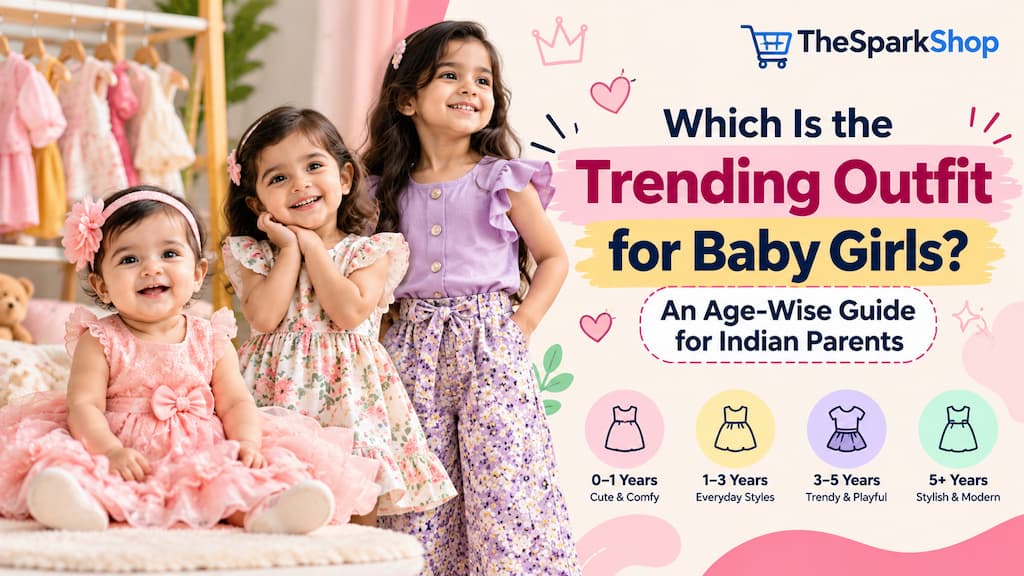
A practical age-wise guide to trending baby girl outfits in India in 2026, covering casual daily wear, birthday and party dresses, ethnic and festive outfits, Indo-Western styles and occasion-specific buying advice, with fabric recommendations for Indian conditions and honest Rs budget guidance.
Where Indian Parents Actually Start When Shopping for Girls Outfits
The search for trending baby girl outfits in India is almost never a casual browse. It starts with a specific event, a first birthday, a Diwali celebration, a school annual day, a naming ceremony and a very real deadline. Most parents already have a rough idea of the style they want. What they need is confirmation that they are buying the right thing for the right occasion, in the right fabric, at a price that makes sense.
The girls kidswear market in India has changed significantly in the past two years. The old default of pink frilly dresses for every occasion and heavy embroidered lehengas for every festival has given way to something more varied and, honestly, more interesting. Lavender has overtaken pink as the dominant colour for first birthdays in 2026. Jacket lehengas have replaced standard lehenga-choli sets for weddings among parents who want something that looks formal but is easier for a child to move in. And Indo-Western has become as common at family gatherings as fully ethnic outfits.
This guide organises trending baby girl outfits in India in 2026 by occasion first and age second, because that is how parents actually shop. If you are looking for what to wear to a specific event, jump to that section. The fabric and budget guidance at the end applies across all categories.
If you are also looking for trending outfits for boys, we have covered that separately in our guide to trending outfits for boys in India 2026.
Daily and Casual Wear, What Girls Are Actually Wearing Every Day
Casual wear for girls gets the least fashion attention and the most actual use. A dress that works for the park, a playdate, a trip to the supermarket and a school non-uniform day is more valuable in practice than a party outfit that gets worn twice before being outgrown.
The dominant casual trend for Indian girls between 3 and 10 years in 2026 is the printed co-ord set, a matching top and bottom in a coordinated print, sold as a pair. Co-ord sets have taken over from individual separates as the go-to casual option because they eliminate the outfit decision entirely. The colours trending strongly are sage green, dusty rose, lavender and terracotta, moving away from the bright primary palette that dominated earlier years. These muted, earthy tones photograph well and look put-together without effort.
For toddlers and babies between 0 and 3 years, the sleepsuit or romper remains the most practical daily option. In 2026, the trend within this category has moved toward animal print rompers, nature-themed prints (leaves, mushrooms, small flowers) and unstructured cotton frocks with elastic waists that do not restrict movement. Parents of very young girls consistently report that anything with complicated closures, multiple buttons down the back, ties that need to be adjusted, gets worn less simply because changing nappies twenty times a day makes fuss a dealbreaker.
For older girls between 8 and 12, the trend mirrors what is happening in adult women’s fashion at a smaller scale: oversized printed T-shirts worn as dresses, co-ord sets with wide-leg trousers and midi skirts paired with plain fitted tops. This age group is also where personal preference starts to matter in a way it does not for younger children, girls increasingly have opinions about what they wear and outfits that feel age-appropriate rather than babyish get worn more.
ALSO Read:
Birthday and Party Dresses, The Most Searched Category in Girls Fashion
First birthday outfits alone account for a significant portion of all girls kidswear searches in India and for good reason, a first birthday is photographed more than almost any other childhood event and the outfit needs to hold up across a multi-hour celebration while making a visual impact in photographs.
The colour story for girls birthday dresses in 2026 is led by lavender, which has genuinely displaced pink as the first choice for Indian parents shopping for first birthday outfits. Sage green is the second fastest-growing colour in this category. The reason for this shift is partly social media aesthetics, earthy and muted palettes photograph better in the soft-light style that dominates Indian baby photography in 2026 and partly a broader move away from the all-pink default that felt mandatory for many years.
For the dress itself, the silhouettes trending most strongly for birthday parties are the A-line frock with a tulle underskirt for girls between 1 and 5 and the fit-and-flare dress or skirt-top set for girls between 5 and 10. Both allow movement, which matters enormously for a child at a party, while looking dressy enough for photographs. Heavily structured gowns with boning or stiff petticoats look beautiful in photographs but make most children miserable within 30 minutes of wearing them. This is worth knowing before spending Rs 2,500 on something that will be removed before the cake is cut.
For birthday parties that are not the child’s own, attending a friend’s birthday, a cousin’s celebration, the practical advice is to choose something slightly less elaborate. A printed midi dress or a co-ord skirt set in a party-appropriate colour (the lavender and sage green trend applies here too) is easier to wear, easier to wash and easier to re-wear than a heavily decorated party gown.
Ethnic and Festive Wear, What Is Actually Working for Indian Families
Ethnic wear for girls covers a wider range of occasions and regional variations than any other clothing category in Indian kidswear. What a family in Punjab buys for Lohri is different from what a family in Tamil Nadu needs for Pongal, which is different from what a Maharashtrian family buys for Ganeshotsav. Any guide that gives one uniform recommendation for Indian ethnic wear is missing most of the picture.
If you want a dedicated occasion-by-occasion ethnic wear guide covering both boys and girls, our kids ethnic wear India guide goes deeper into weddings, festival dressing, state-specific traditions and wardrobe building. Across North India, the lehenga-choli set remains the dominant choice for girls between 3 and 12 for weddings and major festivals. The trend in 2026 has moved toward lighter embroidery and cleaner designs, less heavy stone work and mirror embellishment, more block prints and subtle thread embroidery. This shift is partly aesthetic and partly practical: a heavily embellished lehenga is uncomfortable for an active child, difficult to clean and likely to lose stones and sequins within a few wears. A well-made block print lehenga in a rich colour looks equally festive, is easier to maintain and actually gets worn more than once.
The jacket lehenga has become the standout ethnic trend for girls between 5 and 12 in 2026. A standard lehenga-choli set with a structured jacket on top gives a layered, slightly formal look that works for weddings and larger family celebrations. The jacket adds visual interest and a degree of formality without the weight of a heavily embroidered outfit and crucially it is something an older girl will actually wear willingly because it reads as contemporary rather than traditional costume.
For South Indian families, the pavadai sattai (also called langa voni or half sari set) remains the standard for girls between 5 and 12 at temple functions, family weddings and festivals like Onam and Pongal. In 2026, the trend within this category leans toward cotton silk blends rather than pure silk, which is more comfortable for a child and more practical to clean after a festival day. Pastel zari borders have overtaken the heavier traditional borders for younger girls, the look is lighter and easier to wear through a long celebration.
For Diwali and family festivals at home where the occasion calls for ethnic wear but not full formal dressing, the anarkali suit has remained consistently popular for girls between 3 and 10. A cotton or georgette anarkali in a festive colour with simple embroidery is versatile, comfortable and covers the full body, which matters for families where modesty in children’s clothing is a consideration.
Indo-Western, The Style That Now Defines Festive Fashion for Girls
The same Indo-Western shift that has happened in boys fashion has happened in girls fashion, perhaps even more visibly. In 2026, a significant proportion of Indian girls at birthday parties, school annual days and casual family celebrations are wearing some version of an Indo-Western outfit rather than purely ethnic or purely Western clothing.
The most popular Indo-Western combinations for girls in 2026 are: a printed kurta top worn with flared pants or palazzo in a complementing colour, a short embroidered jacket worn over a plain maxi dress and a lehenga skirt worn with a Western-style crop top or fitted blouse rather than a traditional choli. Each of these combinations is easier to pull together than a full ethnic set, more comfortable for a child to wear for extended periods and photographically versatile.
For younger girls between 2 and 6, the kurta-and-legging set continues to dominate as the easiest Indo-Western format for parents. The outfit reads as ethnic in photographs (particularly if the kurta has some embroidery or print) while being as comfortable and practical as everyday Western clothing. Brands like Hopscotch have made this their signature format for festive kidswear and it is now widely available across price points from Rs 400 to Rs 2,500.
One Indo-Western category that has grown significantly in the past year is the dhoti pant set for girls. A wide-pleated dhoti pant in a solid colour paired with a matching or contrasting printed top has a distinctly contemporary Indian aesthetic that works for school events, family celebrations and festive occasions. It is also extremely comfortable, the wide, unrestrictive cut makes it suitable for a child who will be running around for three hours.
School Events and Annual Day, The Category Parents Struggle With Most
School events create a specific and recurring buying challenge for Indian parents: you need an outfit that meets an often vague brief (smart casual, traditional, festive, cultural theme), is appropriate for a public stage performance or school gathering and can be bought quickly and inexpensively because the child will outgrow it before the next year’s event.
The honest answer for most Indian school annual day requirements is a well-fitted salwar kameez set in a solid colour or simple print. It satisfies almost every school function dress code, photographs well at any time of day and can be re-worn for Diwali, a family gathering and the next school event. Building this into a girl’s wardrobe early, one decent salwar kameez in a versatile colour like rose pink, off-white or soft green, eliminates the last-minute scramble that school functions typically produce.
For school sports days and physical activities, the same principle applies as in boys fashion: dry-fit fabric and loose-fit designs are the practical choice. Girls’ sports kits should allow full movement without fabric riding up or restricting the arms and legs. A well-fitted dry-fit T-shirt and shorts or track pants in the school colour is more useful than anything more elaborate.
Fabric, The Practical Decisions That Most Fashion Guides Avoid
Indian parents who have dressed a child for a three-hour outdoor birthday party in a synthetic fabric know this already: the outfit matters far less than whether the child is comfortable. Fabric is where many online clothing purchases go wrong, particularly for occasion wear bought based on photographs alone.
For casual and daily wear, 100 percent cotton is the only sensible choice for Indian conditions. It breathes in humidity, tolerates the kind of washing frequency that comes with an active child and does not irritate sensitive skin. Cotton knit (jersey fabric) for T-shirts and dresses is particularly good for younger children because it stretches with movement.
For party wear and birthday dresses, the fabric choices get more complicated. Tulle looks spectacular in photographs but scratches against the skin without a proper cotton lining, so any tulle dress worth buying should have a fully lined skirt. Net and organza party dresses have the same issue, they are beautiful but require a proper inner lining to be comfortable. When buying online, check specifically for lining details. A lined tulle dress at Rs 1,200 is better than an unlined one at Rs 700.
For ethnic wear, the advice mirrors the boys category: cotton and cotton silk blends are the correct choice for any child who will be wearing the outfit for more than an hour. Rayon and viscose drape beautifully and photograph well but are hot and uncomfortable in Indian weather. Polyester embroidered lehengas are widely available at low prices and are almost universally regretted by parents after the first wearing. Pure silk is appropriate for very formal occasions, a family wedding where the child is in the wedding party, but requires careful management and is not suitable for an active child at a long celebration.
Budget Guide, Honest Ranges for Every Occasion
Daily and casual wear for girls should not require significant spending because these are items that will be washed frequently and outgrown within a year. A well-made co-ord set or printed cotton frock from Hopscotch, H&M Kids or Firstcry’s house brands costs Rs 250 to Rs 700. Meesho and Amazon’s kids clothing section offer options from Rs 150 to Rs 400 with variable quality, adequate for items that will be worn to the park rather than to a celebration.
Birthday and party dresses occupy the Rs 600 to Rs 2,500 range for most Indian families. A lined tulle birthday frock for a first birthday from a mid-market brand costs Rs 800 to Rs 1,500 and is genuinely worth spending on because first birthday photographs have long life. For attending other children’s parties, the Rs 400 to Rs 900 range is sufficient and sensible.
Ethnic wear ranges from Rs 500 for a simple cotton kurta-pyjama set to Rs 3,500 to Rs 6,000 for an embroidered lehenga with jacket from a dedicated ethnic kidswear brand. The jacket lehenga sets that are trending in 2026 sit in the Rs 1,500 to Rs 3,000 range at brands like Manyavar Mohey Kids, Biba Kids and Kalki Fashion’s kids line. For South Indian pavadai sattai sets, Rs 800 to Rs 2,000 covers the mid-market range with cotton silk blends.
The timing advice that applies universally: Firstcry’s Big Baby Sale in January and July offers 30 to 50 percent off ethnic and occasion wear. End-of-season sales at Hopscotch and H&M Kids in January and August are the best time to buy casual and daily wear for the next season. Buying one size up during these sales extends the use of occasion wear by a full year, which at the rate children grow is the single most practical economy available.